



4 / 5
Customers recommend us
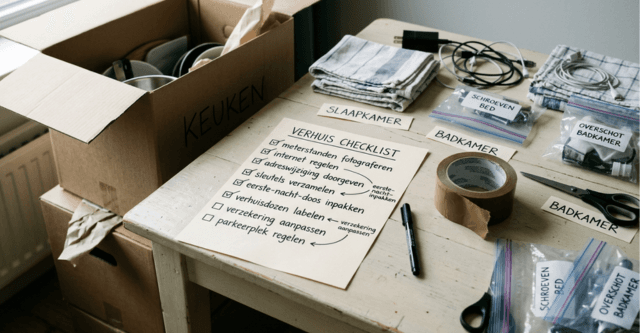
A move is dozens of small tasks that all have to happen at the right moment. With this checklist you'll miss nothing: from arrangements you make weeks ahead to the last things on moving day itself — plus everything you need to notify. Work through it phase by phase and keep a clear head.

A move is dozens of small tasks that all have to happen at the right moment. With this checklist you'll miss nothing: from arrangements you make weeks ahead to the last things on moving day itself — plus everything you need to notify. Work through it phase by phase and keep a clear head.

Calm comes from planning. Start early and spread the work across the weeks, so nothing piles up on moving day itself. Below is the timeline from six weeks ahead to after the key handover. For what it all costs, see our guide on moving costs.
Lay the groundwork. Give notice on your rental or arrange the transfer of your bought home with the notary, and set a moving date. Request special leave from your employer and arrange help — friends or a moving company (book that 4-6 weeks ahead). Start decluttering early: the less you bring, the cheaper and easier the move. Arrange care for kids and pets on the day itself.
Sort the paperwork. Register with your new municipality (allowed from 4 weeks before to 5 days after), set up mail forwarding, and start your change-of-address notifications (see the list below). Order or borrow moving boxes and packing materials. If needed, request a parking permit or a spot for the van, and book a furniture lift for an upper-floor flat.
Start packing. Work room by room, label every box with contents and destination, and keep a 'first-aid' box apart (charger, toiletries, coffee). Disassemble what you can and store screws in labelled bags. Clean the old home and plan the handover. Eat down your fridge and freezer towards moving day.
Defrost the fridge and freezer a day ahead and fit the washing machine's transit bolts. On the day itself, note the meter readings (with a photo) in both homes, gather important documents and some cash, and protect floors and door frames. After loading, check every room and cupboard before you close the door.
Leave the fridge off for about a day before switching it on again (to settle). Finish your change-of-address notifications, check that mail is being forwarded, and return borrowed items or the rental van. Introduce yourself to the neighbours. And don't rush: a house becomes a home step by step.
Sometimes the timing doesn't match: you have to leave your old home before the new key arrives, or you want to move calmly in stages. Inbox Storage picks up your belongings at home, stores them dry and secured at our hub in Gouda, and brings them back whenever you want. That bridges the gap between two homes without parking everything at a relative's. How much lifting help you'd like is your choice at booking.
🏛️ Register with your new municipality: from 4 weeks before to at most 5 days after.
📸 Note the meter readings in both the old and new home — and take photos.
🌀 Fit the washing machine's transit bolts before transport.
❄️ Let the fridge settle for ~1 day after the move before switching it on.
No van, no backache, no contract you can't escape. Calculate in 60 seconds what storage during your move costs.
Calculate in 60 seconds at Inbox Storage what storage during your move costs.
Enter your postcode and see in 60 seconds what storage during your move costs. No obligation, no hassle.
DONE IN 60 SEC.
A new address means a round of authorities and subscriptions. Tackle it in blocks so you forget nothing. These are the main ones.
Register with your new municipality (from 4 weeks before to 5 days after). Sort a waste pass, and remember the tax office and your driving licence and vehicle records. Moving to another municipality? Reclaim prepaid local taxes like dog tax — note: property tax (OZB) is not refunded.
Give your address to your bank, employer and the tax office. Update your insurance: health, contents, buildings, liability and car. Check whether you qualify for rent allowance or an employer moving allowance, and adjust your commuting allowance if needed.
Close gas, water and electricity at the old address (with meter readings) and register at the new one. Arrange internet and TV in time — there's often a waiting period. For a rental, reclaim your deposit and record the handover with the landlord or owners' association.
Update your subscriptions: streaming services, delivery apps, magazines, gym and library. Give your new address to your GP, dentist and pharmacy, and to regular at-home services. Set up mail forwarding for whatever you forget.
🏛️ Municipality: from 4 weeks before to 5 days after the move.
💸 Reclaim your rental deposit and any prepaid local taxes.
📶 Arrange internet and TV early — there's often a waiting time.
✉️ Set up mail forwarding for whatever you forget.
The questions we hear most about planning a move — answered briefly.
Start six to eight weeks ahead with the big things (giving notice, setting a date, arranging help). A moving company is best booked four to six weeks ahead. The earlier you start, the calmer the final week.
You may register from four weeks before the move and are required to do so within five days after the moving date. Do it on time; it's linked to allowances, mail and local taxes.
With the meter readings (and a photo as proof) of both your old and new home, you avoid paying for usage that isn't yours. Record them on the day of the handover.
Defrost the fridge and freezer a day ahead and empty and clean them. Fit the washing machine's transit bolts for transport. Read more in our guide on moving appliances.
Then bridge the gap with temporary storage: your belongings are picked up at home, kept dry and secured, and brought back once your new place is ready. No need to park everything at a relative's or haul it twice.
We pick up your belongings at home, store them dry and secured, and bring them back whenever you want. No lifting, no van, no long contracts.