



4 / 5
Customers recommend us

Last Saturday you sorted out the entire attic, four bin bags to the dump, two boxes to the thrift shop. A month later: that same feeling — full again. That's not lack of discipline. It's four patterns that undermine decluttering, and unless you break them, the clutter keeps coming back. Here they are, plus what to do about each one.

Last Saturday you sorted out the entire attic, four bin bags to the dump, two boxes to the thrift shop. A month later: that same feeling — full again. That's not lack of discipline. It's four patterns that undermine decluttering, and unless you break them, the clutter keeps coming back. Here they are, plus what to do about each one.

Most decluttering guides tell you what to throw out — not why you keep ending up with too much stuff. That's where it goes wrong: tidying is symptom treatment as long as you don't tackle the patterns that cause clutter. Four common traps: no self-questioning when new items come in, no agreements with household members, assigning too much value to objects nobody else does, and not daring to throw out the actual junk. Per trap: the pattern, why it frustrates you, and what works instead.
The easiest way to keep your home full is by not filtering what comes in. An impulse buy on Saturday, a freebie from a neighbour, the company Christmas gift, promo bags from a shop — none of it you went out to find, but all of it shows up. Ask yourself one question with every new item: ‘where will this live, and what’s there now?’ No spot, or the spot’s already taken? Don’t assume it’ll sort itself out. When in doubt: don’t bring it in, or toss something to make room (the one-in-one-out rule).
One person can’t keep a house tidy. If you clean up every Saturday and your partner or kids have no clue where things go, it’s upside down again within a week. Make rules: which space is whose, what does and doesn’t belong in the living room, how often you do a joint thrift-shop run. Start small — for example, ‘everyone tidies their own stuff from the living room before bed.’ Sounds simple, but it prevents 80% of the clutter that otherwise builds up over a week.
Some things you can’t throw out because they mean something — fair. But if everything means something, nothing really does. The porcelain vase from an aunt you barely knew, the bead bracelet from a 2008 holiday, coursework from a finished degree — we attach stories that feel more important than they are. Test: would you call someone to talk about this object? No? Then it probably matters less than you think. Photos often replace the object — the memory stays, the dust in the cupboard goes.
The irony: the real junk — broken stuff, things that don’t work anymore, outdated electronics, empty boxes ‘for when we ever move’ — sits there because you think ‘I’ll look at it again sometime’. But you don’t. A charger for a phone you got rid of 8 years ago, a coffee machine that leaks, 30 plastic shopping bags. That’s not ‘maybe-useful’, that’s junk. Two categories to bin today: (1) anything that doesn’t work or no longer fits, and (2) anything you haven’t thought about in 6+ months. To the dump, not the thrift shop — real junk doesn’t belong in a ‘donation’ pile.
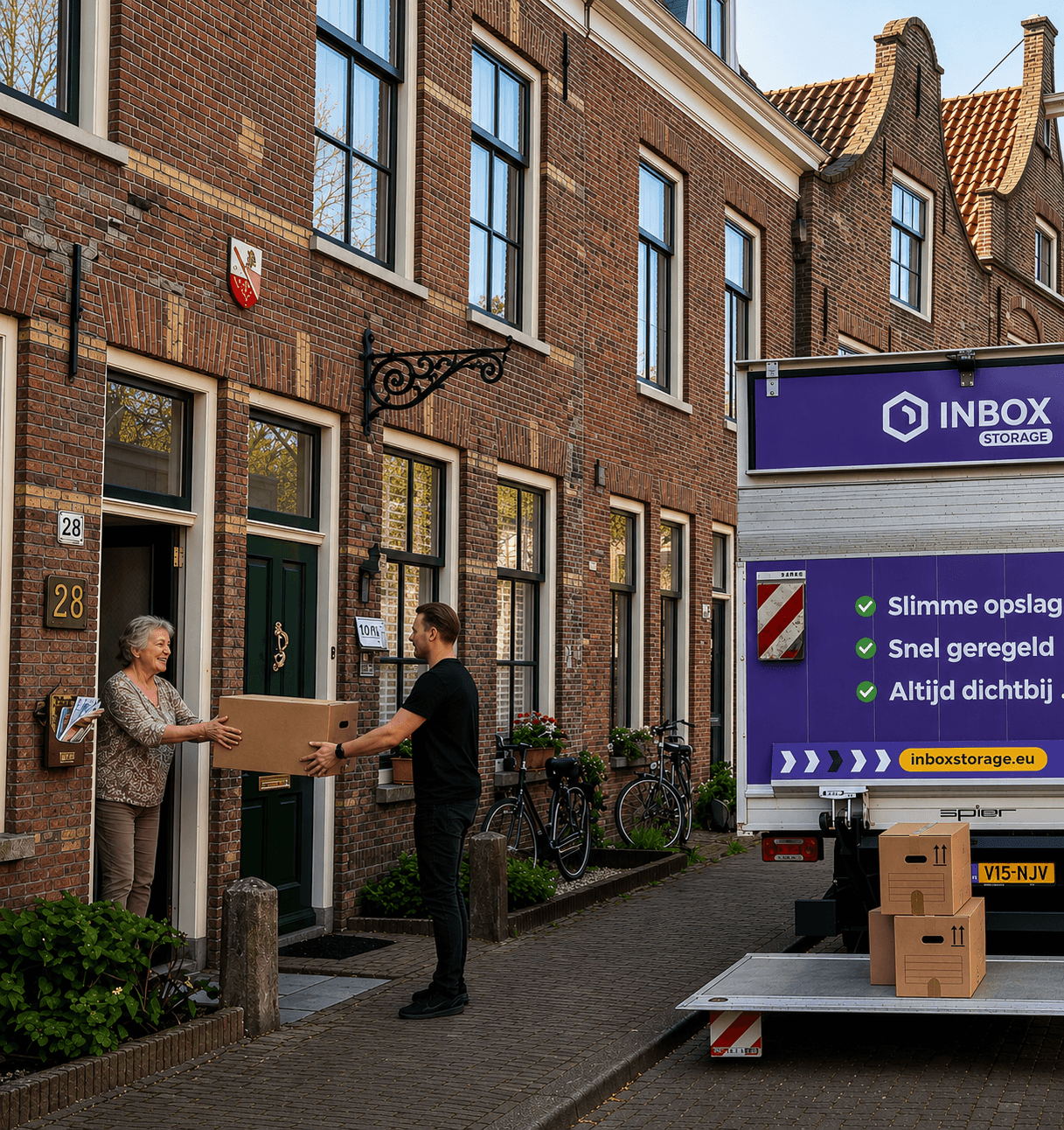
Real decluttering always lands on a maybe-pile: not clutter, not obviously valuable, but in the way right now. A chair from a parent who passed, baby furniture for a possible next child, ski gear you don't touch for 11 months. Throwing out feels too final, keeping eats space. For those things, storage is the answer: not lost, not in the way. We drive to your door across the Netherlands and Belgium — cancel from month 1, so you only pay while you're still deciding.
🛑 One question for every new item: do you know where it will live? If not: don’t bring it in.
👥 Decluttering only works when everyone joins in. Start small — e.g. living room empty before bed.
📷 Photos preserve the memory, the object doesn’t have to. Would you call someone to talk about it? No? It can go.
🗑️ Broken = junk. Don’t donate — to the dump.
By Bram Jansen — head advisor at Inbox Storage. Last updated May 2026. Break the pattern, not just the pile.
Maybe-pile items you can’t lose but can’t keep around? Calculate your price in 60 seconds at Inbox Storage.
Fill in your details so everything is ready and you can proceed right away.
DONE IN 60 SEC.
We drive to your door, pick up your maybe-pile and bring it back when you know what you want with it.